Why Renovating While the Project Is Still Being Drawn Is Not a Very Good Idea
In something as complicated and consequential as building and renovating, haste is not our best friend. One of the questions I am asked most often is whether the renovation can start while the design project is still being drawn, without waiting for it to be finished. It can, but it almost always ends in extra expense and frayed nerves. Here is why.
A renovation is not made for a single year, and it is better to think everything through calmly in advance, so that your home gives you and the people close to you pleasure for years. When the build runs alongside the design work, that considered quality inevitably suffers.
Common problems when renovating in parallel with the design project
The builders need working drawings that do not exist yet
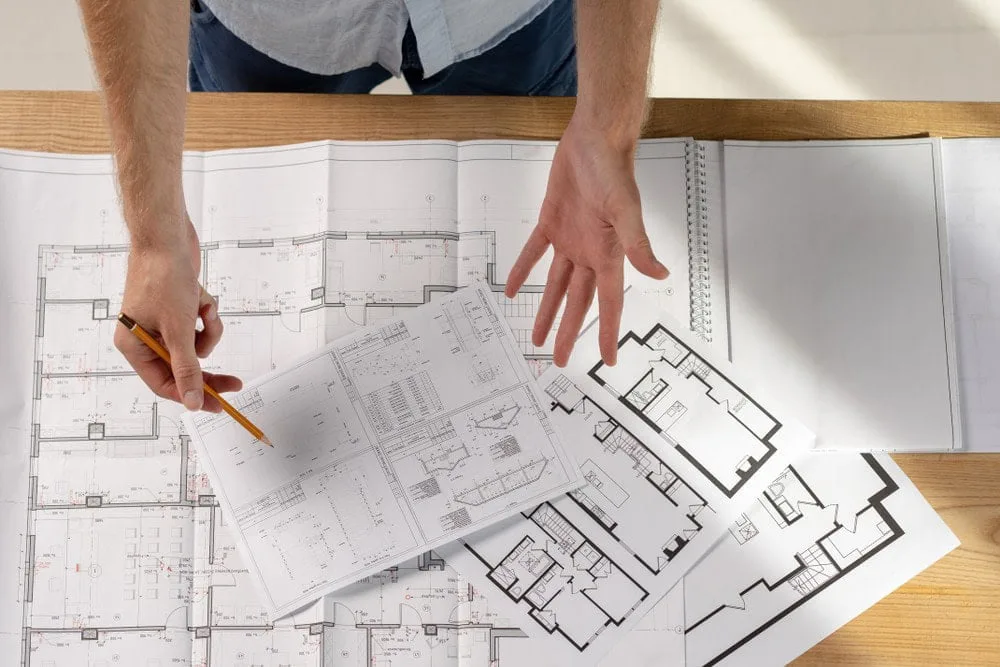
Almost at the very start of the build, the builders ask for the main working drawings. But those drawings are only ready at the third and final stage of the design project. Handing them over earlier without consequences is practically impossible, because the documentation simply has not been brought to a workable state yet.
The electrics and plumbing are done blind
Electrics, lighting and plumbing are worked out from layouts that have already been chosen and approved, with specific furniture and equipment in them. A bed with a 160 cm mattress, for example, may be 165 cm, 175 cm or even 180 cm wide. Without a specific model chosen it is impossible to calculate a comfortable position for sockets and switches: they risk ending up too far from the bed, or behind the headboard.
The choice of materials and furniture narrows sharply
During a build, the choice of materials, furniture, lighting and interior pieces is often limited to whatever is in stock, because there is no longer time to wait for items on order. Decisions then get made on the principle of "what is available right now" rather than according to the project.
Changes on site cost more than changes on paper
Changes on paper are far cheaper than changes on site. If you change your mind and want to do something fundamentally differently, on paper the revision takes a short time, and you have the chance to compare options and make the right decision. During the renovation the same change means extra money and extra time lost.
The order of works gets muddled
When design and construction run at the same time, it is harder to organise the sequence of actions: the project stages get tangled and the chances of mistakes and wrong decisions go up.
When working in parallel is unavoidable
Sometimes a client insists on starting the build as soon as possible, and I usually accommodate that, but I always explain the risks honestly. In those cases I change the standard order of work: first the layout and the construction drawings, which I hand to the client for the builders, and only then do we move on to choosing finishing materials. There is more about this in the article on visualisation and the order of work. And if you can see that working in parallel is possible but comes with compromises, it is worth checking the design project timeline in advance too.
Frequently asked questions
Can the renovation start before the design project is finished?
Technically yes, and I sometimes accommodate a client by changing the order of work. But it carries risks: the choice of materials narrows, changes cost more, and mistakes in the electrics and plumbing become more likely.
Why can the builders not have the drawings at the start of the renovation?
The working drawings are only ready at the final stage of the design project. Early on they have not been brought to a workable state, so handing them to the builders without consequences is practically impossible.
What does the budget risk when work runs in parallel?
Changes made once the build is under way cost considerably more than revisions on paper. On top of that the choice of materials is limited to what is in stock, and mistakes in the position of sockets and equipment have to be redone.